The Luftwaffe over Germany: Defense of the Reich by Donald Caldwell Richard Muller
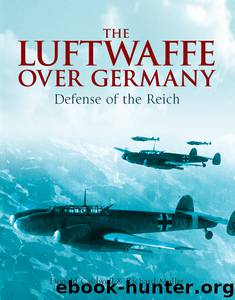
Author:Donald Caldwell, Richard Muller
Language: eng
Format: epub
Tags: HISTORY / Military / World War II
ISBN: 9781473896963
Publisher: Frontline Books
Published: 2014-04-01T16:00:00+00:00
Jagdabschnittsfü Ungarn
Obstlt. Neumann
Budapest
LUFTFLOTTE 3
GFM Sperrle
Paris
II. Jagdkorps
Genmaj. Junck
Chantilly
Jagddivision 4
Oberst Vieck
Metz
Jafü 4
Oberst von Bülow
St. Pol-Brias
Jagddivision 5
Genmaj. Hentschel
Jouy-en-Josas
Jafü 5
Oberst Gollob
Bernay
Jafü Bretagne
Oberst Mix
Rennes
Jafü Südfrankreich
Oberst Vollbracht
Aix
The day-fighter defenses of the Reich and the western occupied zone had now reached their penultimate state of organization, as tabulated above. Jagdabschnittsführer (Jagdabschnittsfü—Fighter Sector Leaders) controlled smaller forces than did Jagd-fliegerführer, sometimes single Staffeln. Jafü 1, Jafü 2, and Jafü 3 had by now been disbanded, their functions having been taken over by their parent Jagd-divisionen. The last major change would come on June 15, when Jafü Ostmark was renamed Jagd-division 8 and left Jagddivision 7.119
Seven Jagdgruppen from the three Wilde Sau Geschwader (JG 300, JG 301, JG 302) were merged smoothly into the day order of battle. According to Willi Reschke, an experienced Wilde Sau pilot, this was “… a period of great day success … The combination of bomber pilots experienced in night and formation flying and aggressive young fighter pilots (most at this time with some bad-weather training) gave good results—each learned from the other.”120
Sturmstaffel 1 received new aircraft in April— special-build Fw 190A-8/R2 Sturmböcke (“assault billy goats” or “battering rams”), which were up-armored and up-armed for the sole purpose of attacking the bomber Pulks. The Sturmbock was 180 kg (400 pounds) heavier than the standard Fw 190A-8, with external armor plate bolted around the cockpit and the gun troughs and laminated 30-mm-thick glass panels on the front and sides of the canopy. The outer-wing 20-mm cannon were replaced by 30-mm MK 108s firing high explosive shells called Minengranate. Only 55 rounds of ammunition could be carried for each cannon, enough for five seconds of fire. The Staffel’s standard rear attack to close range was deemed to be ideal for maximizing the destructive effect of these weapons.121
On April 2, the Fifteenth Air Force bombed two major targets in Steyr, Austria: a ball-bearing factory and an aircraft assembly plant. The Fifteenth still had only three P-38 groups and one P-47 group for escort, but this time staged them better to support the penetration leg of the mission. This undoubtedly saved many bombers, because Jafü Oberitalien and Jagddivision 7 responded early, and with maximum force, aided by the presence of a Fühlungshalter airplane from Osoppo and a straight-line course to Steyr by the bombers. The one Italian and two German Bf 109 Gruppen based in northern Italy attacked the stream and claimed 11 bombers, but were then driven off by the P-38s and P-47s. Jagddivision 7 called on Jagddivision 3 and was able to form nine Jagdgruppen and three Zerstörergruppen into three Gefechtsverbände, which attacked before, over, and after the target area. The Bf 110s had one of their last truly successful days in the RLV; 62 took off, and all made contact, attacking both the B-17 and the B-24 streams from the rear, with rockets. Claims by the twin-engine crews totaled five B-17s, three B-24s, and one P-38, for the loss of eight, most to 14th Fighter Group P-38s. The 312 single-engine fighters also attacked primarily from
Download
This site does not store any files on its server. We only index and link to content provided by other sites. Please contact the content providers to delete copyright contents if any and email us, we'll remove relevant links or contents immediately.
| Africa | Americas |
| Arctic & Antarctica | Asia |
| Australia & Oceania | Europe |
| Middle East | Russia |
| United States | World |
| Ancient Civilizations | Military |
| Historical Study & Educational Resources |
The Radium Girls by Kate Moore(12036)
100 Deadly Skills by Clint Emerson(4932)
Rise and Kill First by Ronen Bergman(4797)
The Templars by Dan Jones(4695)
The Doomsday Machine by Daniel Ellsberg(4493)
The Rape of Nanking by Iris Chang(4224)
Killing England by Bill O'Reilly(4008)
Stalin by Stephen Kotkin(3973)
Hitler in Los Angeles by Steven J. Ross(3949)
12 Strong by Doug Stanton(3554)
Hitler's Monsters by Eric Kurlander(3350)
Blood and Sand by Alex Von Tunzelmann(3207)
The Code Book by Simon Singh(3197)
Darkest Hour by Anthony McCarten(3137)
The Art of War Visualized by Jessica Hagy(3014)
Hitler's Flying Saucers: A Guide to German Flying Discs of the Second World War by Stevens Henry(2759)
Babylon's Ark by Lawrence Anthony(2686)
The Second World Wars by Victor Davis Hanson(2529)
Tobruk by Peter Fitzsimons(2521)
